
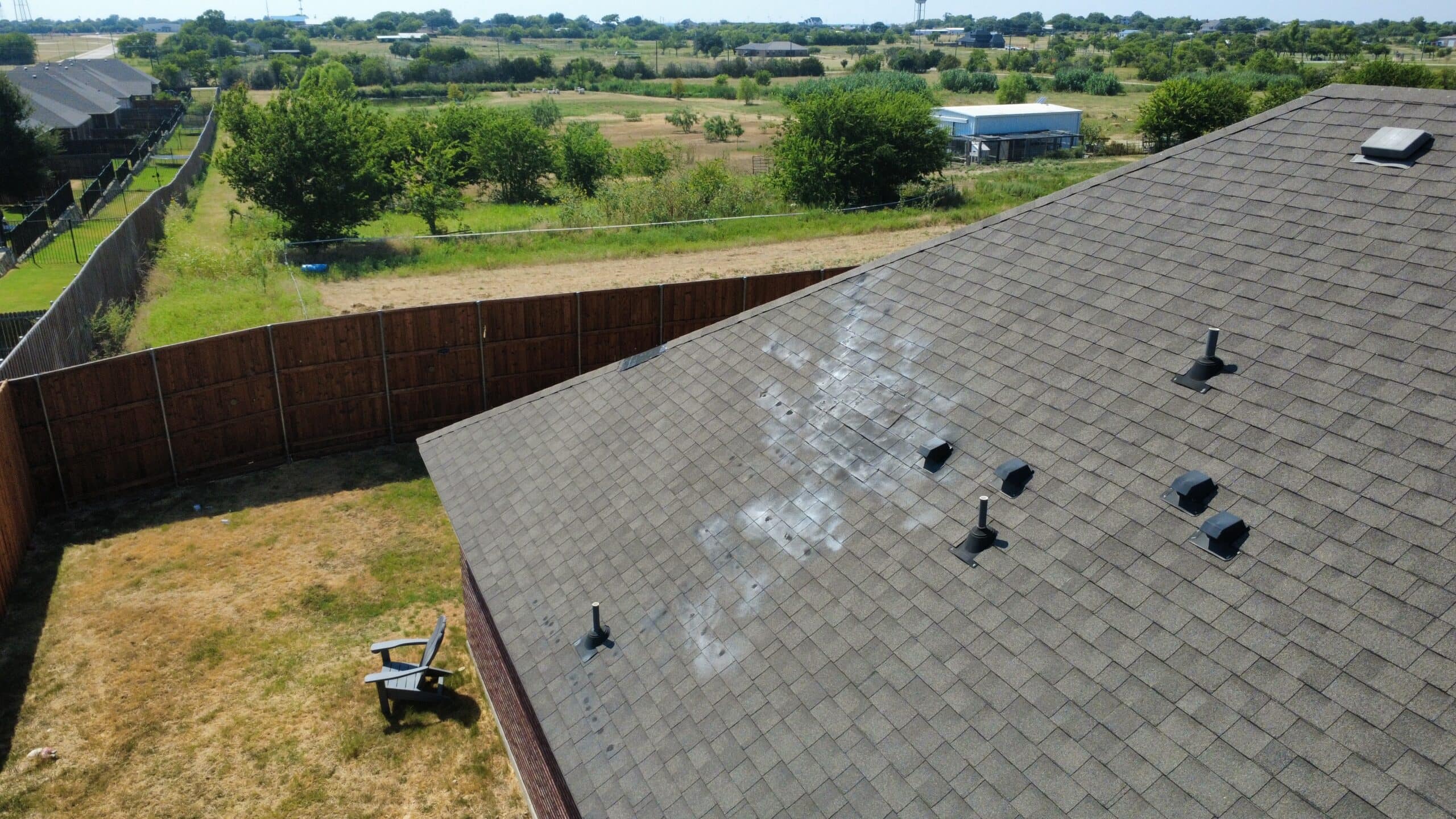
Here’s a situation we run into a few times a season. Hail comes through, the adjuster writes an estimate to repair one slope, and the homeowner is told to get it patched. Then the roofer pulls a permit, the city looks at the scope, and the job stops.
The reason is a line in the building code that most homeowners have never heard of, and that a fair number of adjusters would rather not bring up.
What the rule actually says
Section R908.3.1 of the 2018 International Residential Code — adopted across most DFW jurisdictions — reads:
“Not more than 25 percent of the roof covering of any building or structure shall be removed and replaced in any 12-month period unless the entire roof covering is replaced and is made to conform to the requirements of this code.”
In plain terms: once you cross a quarter of the roof covering inside a twelve-month window, you don’t get to keep patching. The code requires the whole thing come off and go back on to current standards.
Two details matter and get glossed over constantly.
The twelve months are cumulative. Two separate 15% repairs eight months apart are not two small jobs. They’re 30%, and the second one triggers the rule.
How the 25% gets measured is not settled. The code text says “roof covering of any building,” which reads whole-roof. A lot of adjusters and some jurisdictions apply it per slope instead — a 1,000 square-foot slope with 250 square feet of damage hits the threshold on its own. Per-slope is the more favorable reading for a homeowner, and it’s common, but it isn’t universal. Your city’s permit office is the authority, not your adjuster and not us.
Why this shows up in insurance fights
Because it changes the number.
An adjuster writes a repair. The repair, once scoped honestly, crosses 25%. Code now requires full replacement. The gap between “patch the south slope” and “replace the roof” in DFW is often the difference between a $3,000 estimate and a $14,000-$28,000 one.
The mechanism that’s supposed to cover that gap is ordinance or law coverage — the part of your policy that pays for code-required upgrades triggered by a covered loss. Most Texas homeowners policies carry it at somewhere between 10% and 25% of the dwelling limit. A lot of homeowners have it and don’t know, because nobody ever had a reason to explain it.
It’s worth finding on your declarations page before you need it. While you’re in there, check how your policy settles a roof loss at all — a growing number of North Texas policies have quietly moved to actual cash value or a roof payment schedule, which changes the math more than the 25% rule does.
What this does not mean
We want to be straight about this, because the 25% rule gets used as a sales lever and it shouldn’t be.
It is not a rule that says “any hail damage means you get a new roof.” Plenty of storms leave damage well under the threshold, and the honest answer on those roofs is a repair. About half the time we fly a roof after a storm, the answer is that it’s fine and the homeowner shouldn’t file anything at all.
It is also not something a contractor gets to declare. It’s enforced through the permit, by the city. Any roofer telling you the 25% rule guarantees you a replacement, before anyone has measured the damage, is selling.
How you’d actually establish it
You need the damaged area measured, not estimated by eye from a ladder.
That’s the practical argument for aerial documentation. We fly the roof with an EagleView-certified drone, which gives measured slope areas and annotated photos of each impact — so the damaged square footage is a number on a page rather than a disagreement. You get the written report inside 24 hours whether you file anything or not.
If the numbers land under 25%, we’ll tell you that too, and quote you a repair.
Common questions
Does the 25% rule apply to wind damage as well as hail?
It applies to the roof covering being removed and replaced, regardless of what damaged it. Wind, hail, a fallen limb — the trigger is how much comes off, not the cause.
Does a full replacement mean I also have to add things the old roof didn’t have?
Sometimes, and that’s the point of the phrase “conform to the requirements of this code.” Depending on your city and the age of the original install, that can mean ice-and-water shield in valleys, drip edge, updated fastening patterns, or ventilation that meets current requirements. Those are exactly the items ordinance or law coverage exists to pay for.
My roof is 18 years old and the damage is about 20%. What happens?
Under the threshold, so code doesn’t force a replacement. But on a roof that age, a repair means matching 18-year-old weathered shingles, and the color match will be visible. That’s a conversation about whether the repair is worth doing rather than a code question.
Can my insurance company refuse to pay for a code-required replacement?
They can take the position that the damage doesn’t cross the threshold, which is why the measurement matters. Whether ordinance or law coverage applies depends on your specific policy language. If your claim gets denied or comes back low, our walkthrough of how the Texas claim process works covers the sequence.
If you want the measurement
Texan Roofworks is veteran-owned and woman-owned, fully insured with $2M general liability, EagleView certified, with crews working DFW year round.
Free drone inspection, no obligation. Call (972) 584-7849 or book a time.
We work Dallas, Fort Worth, Plano, Frisco, McKinney, Southlake, Keller, and the rest of the metroplex.
General information about building code and insurance practice in Texas, not legal advice. Your city’s permit office and your policy language govern.