
By late August a North Texas roof has been through about four months of the worst thing that happens to it — and it’s not hail. It’s heat. Attic temperatures in DFW routinely run 130-150°F through July and August. Shingles bake, the asphalt loses its flexibility, the sealant strips that hold each course down soften and re-set, and everything on the roof that’s made of rubber or plastic gets a little more brittle than it was in April.
None of that leaks. That’s the problem. Heat damage is quiet, it’s cumulative, and the first time most homeowners hear about it is when a fall or winter cold front turns a small opening into a stain on the ceiling.
Here’s what’s actually worth checking before the first real front comes through.
1. Pipe boots — the number one leak we find in DFW
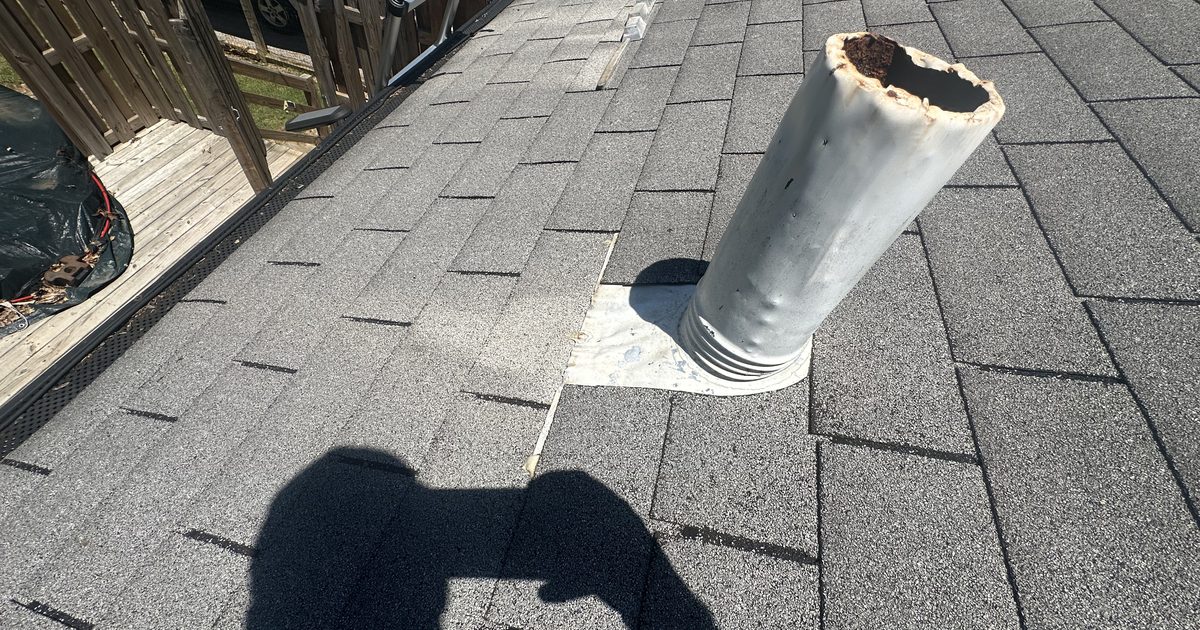
The rubber collar around every plumbing vent on your roof is the shortest-lived thing up there. Standard neoprene boots crack in 8-12 years in this climate, and Texas sun is what kills them. They split at the top of the collar, water runs down the pipe and into the attic, and the stain shows up on a ceiling six feet away from where the actual hole is.
From the ground you can sometimes see the collar has gone chalky gray instead of black. That’s a bad sign. A pipe boot replacement is a couple hundred dollars. The drywall, insulation, and paint it protects are not.
2. Sealant at every penetration
Anything that comes through the roof deck — vents, flashing, satellite dish mounts, solar attachments — was sealed at install. That sealant has a life. After a couple of Texas summers it shrinks, pulls away from the metal, and opens a hairline gap. It’s the same failure mode as a caulk line around a bathtub, just with worse consequences.
3. Shingle granules in the gutters and downspout splash blocks
Some granule loss is normal, especially on a roof in its first year. A pile of what looks like coarse black sand at the bottom of your downspouts is not. Granules are the shingle’s sunscreen — once they’re gone, the asphalt underneath is exposed and it goes downhill fast.
This one you can check from the ground in about five minutes. Walk the downspouts. Look at the splash blocks.
4. Anything that got hit in April or May and never got looked at
DFW took hail on April 25-26 and again in May, with Southlake and Keller catching a real one. A lot of those roofs never got inspected because there was nothing obviously wrong. That’s normal — hail damage usually doesn’t leak right away. It bruises the mat under the shingle, the granules come off at the impact point, and the failure shows up one to three seasons later.
Fall is when that bill comes due, because the first cold snap contracts everything and a bruise becomes an opening. If your roof was under one of those storms and nobody has documented it, that’s the item on this list worth doing first.
5. Attic ventilation and daylight
Go into the attic on a bright day with the lights off. Any daylight you can see through the deck is a hole. Any dark streaking on the underside of the plywood is water that’s been getting in for a while. And if the attic is 150°F with the house running, your ventilation isn’t keeping up — which is exactly what cooked the shingles in the first place.
6. Trees
Limbs that cleared the roof in spring have grown. Anything within about six feet of the roof plane is going to abrade shingles every time the wind blows, and it drops debris into valleys where it holds water against the roof. Trimming is cheap. It’s also the one item on this list you can hire out to somebody who isn’t a roofer.
What we’d actually do
We fly the roof. Our AI drone inspection is EagleView certified, it takes about 30 minutes at the house, and you get a written PDF with annotated photos inside 24 hours. If there’s storm damage, that report is documentation your carrier’s adjuster can use directly. If there isn’t, you have a dated baseline of your roof’s condition — which is worth having the next time a storm rolls through and somebody knocks on your door claiming your roof is totaled.
About half the time the honest answer is that the roof is fine and you shouldn’t file anything. We’ll tell you that. It costs you nothing either way.
Common questions
How often should a DFW roof be inspected?
Twice a year is the textbook answer — spring and fall. Realistically, once a year plus after any hail event is what matters in this market. DFW gets hit often enough that storm-driven inspections do most of the work.
Does heat damage qualify for an insurance claim?
No. Insurance covers sudden events — hail, wind, falling limbs. Heat and age are wear and tear, and every homeowners policy in Texas excludes them. That’s part of why documenting actual storm damage when it happens matters so much.
Is it too late in the year to replace a roof?
Not close. Fall is the best installation window we get in North Texas — mild temperatures, low humidity, and shingles seal properly instead of scorching or refusing to set. Roof replacement in DFW generally runs $14,000-$28,000 depending on size, pitch, and material, with permits in the $115-250 range.
Will my insurance cover a full replacement?
That depends on how your policy settles a roof loss, and a lot of North Texas policies have changed on that point. Worth reading: ACV vs. RCV and roof payment schedules in Texas.
If you want it looked at
Texan Roofworks is veteran-owned and woman-owned, fully insured with $2M general liability, with crews working DFW year-round — we’re already here when the storm hits, not rolling in from out of state after one.
Free drone inspection, no obligation. Call (972) 584-7849 or book a time online.
We work Dallas, Fort Worth, Plano, Frisco, McKinney, Southlake, Keller, Arlington, and the rest of the metroplex.